← Customer stories

Customer story · Enterprise IT

One governed platform for engineering agents, in production at three vehicle manufacturers

Engineering teams are building AI agents now, each on its own data and its own rules. moveOS gives them one platform to build on, with access, audit and data location controlled by IT.

Written for
Enterprise IT, architecture and security
Engineering scope
Test, simulation and validation
Deployment
Dedicated instance, or the customer's own cloud
Security
SOC 2 Type II. Every customer security assessment passed to date

48 h in 15 min

Test data reviewed by a heavy truck manufacturer. The manual review took 2 days.

3 days to 4 h

Validated vehicle model at an OEM motorsport program.

1 week to 1 h

Time to build a new vehicle analysis at Pagani.

The problem

Every team builds its own agents

Engineering teams are not waiting. Each team is building its own agents on its own data. Many of these tools end up as scripts and HTML pages running on one engineer's laptop.

None of these tools share access control, audit logs or a way to reuse work. IT cannot see what exists, who built it, or whether it gives the right answer. IT is left with two poor options: block the work, or review every tool one by one.

“We know the models can do it. Now we need one unified place to do it, not a bunch of different POCs.”
Engineering leadership, global automaker

The approach

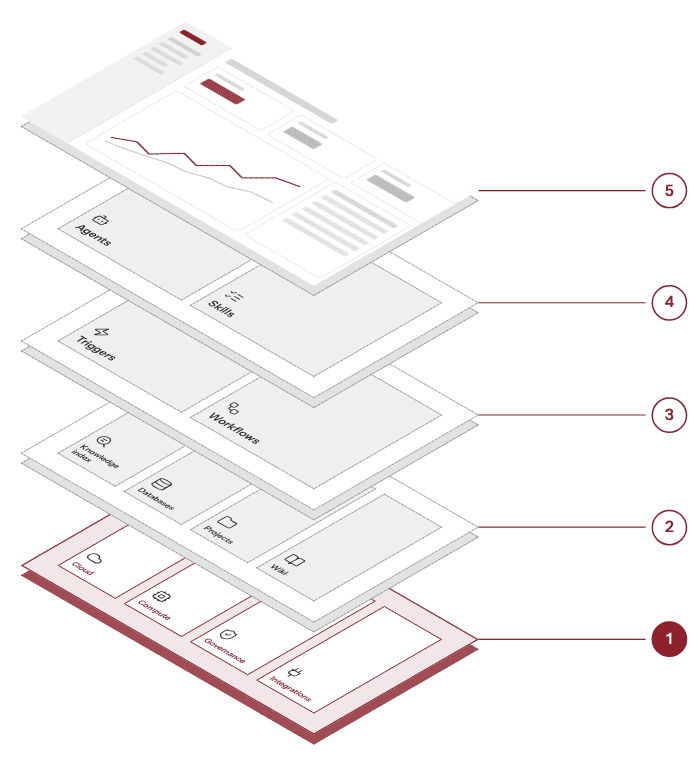
One platform in five layers

The five layers of moveOS. The Foundation, owned by IT, is highlighted.
5. Apps and interfaceDashboards and tools that engineers build and share.Engineers
4. Agents and skillsAgents that do the work. Skills that store a proven method.Engineers
3. WorkflowsData pipelines that run on a trigger, such as a new test file.Engineers, run by agents
2. Company knowledgeA knowledge index and databases over the harmonised data.Engineers, kept current by agents
1. FoundationCloud, compute, governance and integrations.IT

How it works

The platform in five blocks

  1. 1.One data foundation for the whole enterprise

    Test data, simulation results, models, documents and requirements are connected in one place. Data is harmonised once. Every team and every agent then reads the same version. The platform sits on top of existing storage. It does not ask teams to move their source systems.

    In production: At the heavy truck manufacturer, one test truck produced 373 signals across about 120 planned test lines in 7 weeks. All of it landed on one foundation.

  2. 2.Agents run the backend

    Each agent has one job. Separate agents run the backend, the databases, the workflows and the apps. One agent coordinates the whole project. Workflows start on a trigger, so no engineer has to launch them. Agents also run simulation software on workstations and HPC clusters connected to the same platform.

    In production: The heavy truck manufacturer runs this setup, with its apps pinned to each project page. Every test file was checked the moment it landed. At the motorsport program, correlation starts on its own when track data arrives.

  3. 3.Engineers store their expertise as skills, methods and workflows

    An engineer describes a method once. The agent builds it on the team's own data and models. A method that works is saved as a skill. It then runs the same way every time. The engineer defines the question, reviews every result and makes every decision.

    In production: At Pagani, a braking analysis that needed about a week of development was built in about an hour. It is now reused on each new test session.

  4. 4.Knowledge and skills are shared across the organisation

    What one engineer learns is stored in a central knowledge system. A colleague's next study starts from that knowledge with no handover. Sharing follows access rights. A user or an agent only sees what that user is allowed to see.

    In production: At Pagani, one engineer's documented study of a control unit was used in the department head's supplier specification. Nobody passed it on.

  5. 5.Engineers build, validate and track their own apps

    Engineers build the tools they want, such as dashboards that compare test results. Before a team relies on a tool, it can be validated against benchmarks. Every app, workflow and skill lives in one place, so IT can see what exists. Apps run on the same data and access model as everything else.

    In production: Pagani's vehicle dynamics engineers build their own comparison dashboards on the platform.

Results

What three deployments show

A heavy truck manufacturer

What the team does

Full-vehicle test campaign for a validated vehicle model.

Agents check every test file as it lands.

Measured result

48 hours of data reviewed in 15 minutes. The manual review took 2 days.

Tread depth result in 15 minutes. It took 2 weeks before.

An OEM motorsport program

What the team does

Vehicle model correlation against track data.

Agents work inside the program's own toolchain.

Measured result

Validated vehicle model in 4 hours. It took 3 days by hand, for one car.

Three cars correlated in 1.5 hours, between sessions.

Pagani

What the team does

Vehicle dynamics studies across test and simulation.

Engineers build analyses, apps and skills themselves.

Measured result

New vehicle analysis built in about 1 hour. It took about 1 week.

About 6,000 damper variants compared in 1 hour.

For IT

What IT controls

MOVEdot works with enterprise engineering organisations that are deploying AI agents. We know what IT needs to keep them protected. We work through each deployment with your IT team.

Where it runs
A dedicated instance per customer. Data, files and analyses are isolated to that instance. It can also be deployed in the customer's own cloud.
Who sees what
Agents follow each user's existing access rights. Administrators provision users, assign roles and set permissions.
Audit and cost
Administrators review activity by user, team and period. Weekly and monthly cost caps can be set.
Model providers
moveOS only uses models with zero data retention. Model providers keep no customer data after processing. Customer data is not used to train any model.
Ownership
The customer owns its data and everything built on it: skills, workflows, agents, analyses and reports.
Support
A named MOVEdot team for onboarding and support. Engineers on site when needed.
Security review
SOC 2 Type II certified. MOVEdot has passed every customer security assessment to date.

Getting started

Head start, and a clean exit

Ready on day 1

All five layers are already running in production. Integrations to engineering data and simulation tools are ready. So is the console for access, audit and cost.

What to measure in 90 days

Measure the time from an engineer's question to a working analysis. Count the skills a second team reuses. Track the IT effort to bring that second team on board.

How a customer can leave

A first phase runs in parallel with current work and replaces nothing. If it stops, teams go back to working as before. The data and skills built on the platform stay the customer's.

Bring your IT team into the conversation

A 60-minute architecture and security walkthrough with your IT team.

Security at MOVEdot

Sources: customer case studies with MOVEdot (Oct and Nov 2026), customer statements and the moveOS terms. Customers are named only where they have approved it.

Your privacy choices

With your permission, we measure visits, clicks, and campaign performance and can link browsing activity to contact details you submit. Optional tracking stays off until you accept. Cookie policy.